Gerhard Bohrmann
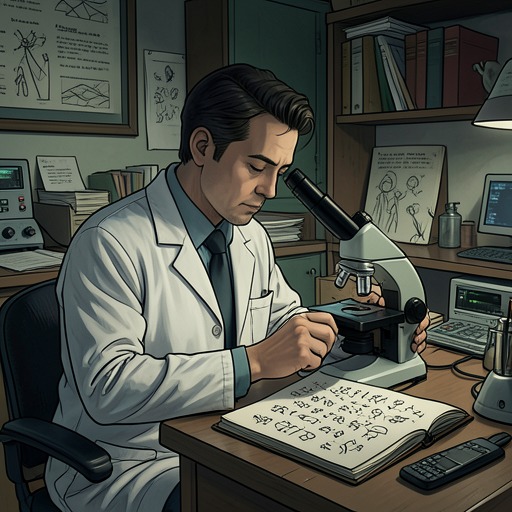
The SwarmGerhard Bohrmann is a marine scientist whose research into methane hydrates and deep-sea ecosystems brings the novel’s oceanic anomalies into view as connected physical processes. He helps explain the instability of the seabed, recognizes that living organisms may be accelerating it, and warns of consequences extending far beyond the research sites. His expertise does not give him control over events: even as he works to understand the danger and alert others, communication fails, the slope collapses, and he is eventually trapped underwater. After the crisis, he returns to diving to assess the damage.
Research and deep-sea experience
Bohrmann enters the story as a scientist with direct experience of the difficulties of studying the deep ocean. He meets Sigur Johanson aboard the Sonne and describes a sampling expedition in which a grab sampler returned from nearly eight hundred metres with hundreds of pounds of sediment containing white lumps. The material was methane hydrate, but much of it did not survive the journey back to the surface. The sample itself made the problem tangible: what scientists brought up from the seabed could change before they had time to examine it.
He explains that hydrates begin to dissociate as pressure and temperature conditions change during ascent. His team saved some of the recovered material by plunging the lumps into liquid nitrogen. The experiment also gives him a practical basis for warning about extraction. A temperature increase of only one degree at a depth of five hundred metres, he says, might destabilize the hydrate stored at that level. The resource could attract worldwide interest, but its apparent abundance does not make it safe or straightforward to recover.
Bohrmann’s authority also rests on firsthand experience in a submersible. He tells Clifford Stone about exploring the seabed off Oregon in Alvin, contrasting the knowledge gained from recorded images with the experience of seeing the underwater landscape in three dimensions while physically present below. When Stone elects to descend in person rather than send Victor ahead to reconnoitre, Bohrmann’s account forms part of the advice behind that choice. He is not only a source of technical data; he understands how the conditions of observation shape what scientists can perceive.
Hydrates, climate, and the limits of prediction
Bohrmann places the current danger in a longer history of climate change. He describes a past episode in which warming destabilized large quantities of methane hydrate, and collapsing continental slopes exposed further deposits. Over hundreds or thousands of years, billions of tonnes of methane entered the ocean and atmosphere. Because methane has a much greater global-warming potential than carbon dioxide, the resulting warming could trigger further hydrate dissociation, forming a reinforcing cycle. In that earlier episode, he explains, deep-water temperatures reached fifteen degrees, compared with roughly two to four degrees in the present ocean.
His account makes clear why hydrate extraction cannot be treated as a routine engineering problem. Methane may burn more cleanly than other fossil fuels, and companies may regard it as an attractive energy source, but Bohrmann distrusts plans that treat ideal operating conditions as a reliable forecast of reality. He warns that industry can select the most favourable outcome from a range of possibilities and proceed without understanding the environment it is entering. His concern is not simply that an accident might occur: the system being disturbed may behave in ways that the planned models do not capture.
At the GEOMAR Centre, Bohrmann and his colleagues monitor experiments using twenty-two cameras and continuous measurements. He shows Johanson white patches of hydrate on the monitors and points out where two polychaetes had been placed the previous morning. The observation links the worm research to the hydrate itself, turning a theoretical concern into a watched interaction. Yet the scale of monitoring does not remove uncertainty. Bohrmann initially resists the conclusion that worms could destabilize hydrates; the idea seems implausible beside the enormous thickness of the deposits and the microscopic scale of the organisms.
That hesitation changes as the evidence develops. He learns that microbial consortia, including partnerships between sulfur bacteria and archaea, can operate in the deep sea, and that such associations have been found on hydrates. Yvonne Mirbach’s revised computer scenarios further challenge the assumptions behind the earlier predictions: the process is not linear, and gas escaping through crumbling hydrate can crack more material, encourage seabed collapse, and accelerate the crisis. Bohrmann’s shift from disbelief to alarm marks a key change in his understanding. The threat is not explained by a single large force, but by interactions whose effects can grow rapidly beyond the assumptions used to model them.
Warning and the Storegga collapse
When Erwin Suess and Mirbach conclude that the collapse will come sooner than expected, Bohrmann is drawn into an urgent effort to warn Johanson. Suess identifies the feared outcome as a Storegga Slide. Bohrmann repeatedly tries Johanson’s home and mobile numbers and contacts his secretary at NTNU, but learns that Johanson is away and cannot be reached. The communication failure is more than a personal frustration: the scientist who might help carry the warning forward is absent at the moment the forecasts are worsening.
Bohrmann also faces the problem of confidentiality. He questions whether the findings should be kept within Statoil and recognizes the reputational cost of suppressing a warning if a major slide occurs. His position is shaped by the tension between incomplete scientific knowledge and the public consequences of silence. He cannot offer certainty about every detail, but he understands that uncertainty is not a reason to treat the danger as negligible.
The collapse follows while the Thorvaldson is fighting through rough seas. A vast section of the continental shelf and slope moves downward, lowering sea level over a wide area and displacing water outward. Close to the slide, across thousands of square kilometres, the resulting wave is so flat that it goes unnoticed amid the storm and rises scarcely a metre above the surface. The scale of the seabed failure is therefore not matched by an immediately visible warning at sea. Bohrmann later explains how people on a coast might recognize an approaching tsunami: rapid fluctuations in sea level, followed after ten to twenty minutes by the retreat of water and the exposure of reefs, rocks, and normally submerged seabed. His guidance turns scientific interpretation into practical warning, even as the disaster demonstrates how easily the signs can be missed.
From European disaster to a wider threat
After the northern European disaster, Bohrmann expects data from Kiel that Suess has been preparing to send. The file contains growth curves for worm colonies and estimates of what similar invasions could mean elsewhere. But transatlantic Internet traffic has stopped, and ordinary phone connections are unavailable or unreliable. The scientists in Kiel continue working intensively, while Bohrmann, like millions of others, cannot receive the information through normal channels. The breakdown of communication compounds the scientific crisis: the need to compare evidence across regions grows just as the systems that would carry it fail.
At the emergency discussions at Chateau Whistler, the scale of the problem remains unsettled. Bohrmann and colleagues at the GEOMAR Centre believe the worm invasion destabilized the hydrates, but he argues that this alone does not fully explain the magnitude of the catastrophe. The wave, he emphasizes, was only the most visible part of a deeper problem. In a later warning, he describes the possibility of further hydrate dissociation in the western Pacific and off the east coast of America, with repeated tsunamis and warming capable of threatening human survival. The prediction extends the concern from one continental slope to a potentially global chain of consequences.
The emergency committee’s debate also places limits on what could have been done. Karen Weaver asks what Bohrmann, Johanson, or Statoil could have done to prevent the disaster; the response is that scientific expertise and direct involvement did not amount to an omnipresent rescue force. The exchange does not erase questions about responsibility, but it distinguishes the ability to recognize and explain a hazard from the power to stop it. Bohrmann’s role is that of a warning scientist, not a person with authority over every institution, vessel, or endangered community.
La Palma and the work after catastrophe
Bohrmann later assists Stanley Frost, a volcanologist assessing unstable island slopes. Frost’s list includes La Palma, Hawaii, Cape Verde, Tristan da Cunha, and Reunion, with La Palma identified as the greatest danger. Thanks in part to Bohrmann’s efforts, Frost’s team obtains the research vessel Polarstern, equipped with Victor 6000 and underwater cameras intended to detect invading organisms. The expedition carries forward lessons from the hydrate crisis: a volcanic slope must be studied not only as rock, but as part of a seabed environment where organisms and geological instability may interact.
Bohrmann’s estimates describe the possible consequences of a failure at La Palma. A large mass of rock could displace enormous quantities of water; the debris might extend sixty kilometres across the seabed and impede water from flowing back over the slide. His calculations put the possible impact speed at 350 kilometres per hour and the height of a resulting wave off La Palma at roughly six to nine hundred metres. The wave could travel across the Atlantic at about a thousand kilometres per hour, though the scenarios differ over what would happen as its energy spread. The figures are presented as estimates, not certainty, but they show why Frost treats the slope as a danger to millions.
Bohrmann travels to La Palma and prepares to deploy a deep-sea suction tube. During the subsequent crisis he is trapped in an underwater cave; after the attacks cease, a rescue squad reaches the seamount and frees him. His survival does not end his work beneath the surface. In the aftermath, he makes repeated dive trips to assess damage to the continental slopes, taking the view that the La Palma events have not made further underwater research unthinkable.
Character and narrative significance
Bohrmann’s arc is defined by the distance between knowledge and control. He can preserve unstable samples, monitor hydrate experiments, recognize the danger of non-linear change, and explain how a seabed collapse might produce a tsunami. Yet he cannot make every warning arrive, overcome failing communications, or command the responses of governments and companies. The novel presents scientific expertise as indispensable but bounded: observation can disclose a threat without granting the observer power to prevent it.
His character also connects the deep ocean’s hidden processes to the visible human consequences of the crisis. Hydrate dissociation, microbial activity, worm colonies, continental-slope failure, and waves are not separate subjects in his account; they are stages in a connected system. Even after the immediate attacks end, his continued dives and the reports that the hydrates are stabilizing keep the seabed present as an ongoing field of investigation. Bohrmann remains a careful interpreter of a world that exceeds easy prediction, and his return to the water signals not mastery but the persistence of scientific responsibility.